
Let’s start with what this article is not.
It is not a guilt trip. It is not a veiled fundraising pitch. It is not an argument that Sunday morning is more important than any other form of devotion. And it is not trying to recruit you into a particular church.
It is an honest answer, from a pastor, to the question “why should I still go to church in 2026?” — with the unspoken assumption that you already know you don’t have to, that church attendance is optional, and that a lot of smart people you respect don’t.
- Christianity is explicitly, unavoidably a group sport. Every metaphor for Christians in the Bible is plural.
- Five things only happen in a room: being known, being corrected, serving outside your gifting, inter-generational contact, and being sent.
- The livestream is a bookmark, not a substitute.
- If church has hurt you, find a healthier one — don’t quit the category.
What the Bible actually says about going to church
Start with the most direct verse. Hebrews 10:24–25: “And let us consider how we may spur one another on toward love and good deeds, not giving up meeting together, as some are in the habit of doing, but encouraging one another — and all the more as you see the Day approaching.”
That’s the one people usually cite. But it’s almost too on-the-nose. The deeper case is everywhere:
- Every metaphor the New Testament uses for Christians is plural: body (1 Corinthians 12), family (Ephesians 2:19), flock (John 10), building (1 Peter 2:5). You cannot be a body part in isolation. You are not a family of one.
- Acts 2 describes the first Christians as meeting daily — not just Sundays — to worship, teach, eat, and share resources.
- Paul’s letters, which make up most of the New Testament, are almost all addressed to churches, not individuals. The Christian life Paul describes is the corporate life.
- The Great Commission in Matthew 28 ends with Jesus’s promise to be with us “to the end of the age” — plural “you,” not singular. He is promising to accompany the gathered church.
None of this is a threat. It’s just the architecture. Christianity was designed to be lived together. You can live it alone, the way you can eat every meal alone — it’s possible, and it slowly makes you strange.
Reason 1: Being known
Sunday morning is not where community happens. Life groups are. But Sunday makes life groups possible. You meet people in a pew who later become the family that helps you move apartments, grieves your mom with you, holds your baby, forgives you when you mess up, and calls you out when you are spiraling.
None of that happens through a screen. None of that happens alone. “Being known” is the biggest single gift of church, and it is almost always the thing lapsed Christians say they miss most.
Reason 2: Being corrected
Most of us carry some blind spot. A habit, a resentment, a way we treat our spouse, a theological wrong turn that has us spiraling. Without other believers speaking into your life, those blind spots grow unchecked.
The Bible is blunt about this. Proverbs 27:17: “As iron sharpens iron, so one person sharpens another.” James 5:16: “Confess your sins to each other and pray for each other so that you may be healed.” Hebrews 3:13: “encourage one another daily… so that none of you may be hardened by sin’s deceitfulness.”
You cannot correct yourself in ways that really matter. You need people who know you well enough to call you out, and who love you enough not to enjoy it.
Reason 3: Serving outside your gifting
Here’s one people rarely name. In a church, you will end up serving in ways you would never choose — pouring coffee when you are an accountant, holding babies when you are a CFO, setting up chairs when you have a PhD. This is actually essential to spiritual formation.
Modern life sorts us by skill and preference. We spend most of our waking hours doing what we are good at, surrounded by people who do the same thing. Church intentionally breaks that pattern. And the research on humility formation (see the Pew data on religious service and well-being) consistently shows that serving outside your comfort zone is where character actually grows.
Reason 4: Inter-generational contact
If you are 28, your Instagram feed is mostly other 28-year-olds. Your coworkers are within a decade. Your friends are in your life-stage. This is historically unusual.
Church is one of the last places in American life where an 80-year-old widow, a 35-year-old dad, a 17-year-old kid, and a 7-year-old first-grader are in the same room on purpose, weekly. The friction — and the healing — of that is irreplaceable. The widow tells the 35-year-old things his parents never did. The 17-year-old watches faith age without souring. The 7-year-old learns that the room has all of these people in it, and her own parents are not the center of it.
You cannot manufacture that community anywhere else in contemporary life. It exists at church, at some family reunions, and almost nowhere else.
Reason 5: Being sent
Every church service ends by sending you out. “The service doesn’t end — it just changes venue.” This is not a clever line; it is the theological shape of Christian worship. You gather to be trained, fed, and reminded whose you are. Then you scatter, Monday through Saturday, to actually be Christians in classrooms, offices, factories, hospitals, and homes.
That rhythm of gather-and-scatter is what keeps faith from becoming either navel-gazing (all gather, no scatter) or burnout (all scatter, no gather). Sunday is the pivot.
If church has hurt you
Read this part slowly. If a past church was abusive, manipulative, politically weaponized, or just painfully fake — that wound is real, and we are sorry. Many people in our church have some version of your story. Our counseling program works with people every week specifically on religious trauma.
Three things we’ve learned:
- Healing rarely happens in isolation. Ironically, the thing that hurt you in church often heals in a healthier church.
- Try three before you quit the category. Churches vary enormously. A megachurch in Orange County and a neighborhood church in Vermont have almost nothing in common besides the name. Sample three before deciding.
- Go small. Start with a visit where you don’t tell your story. Sit in the back. See if your nervous system relaxes. If not, try another one.
What a first visit actually looks like
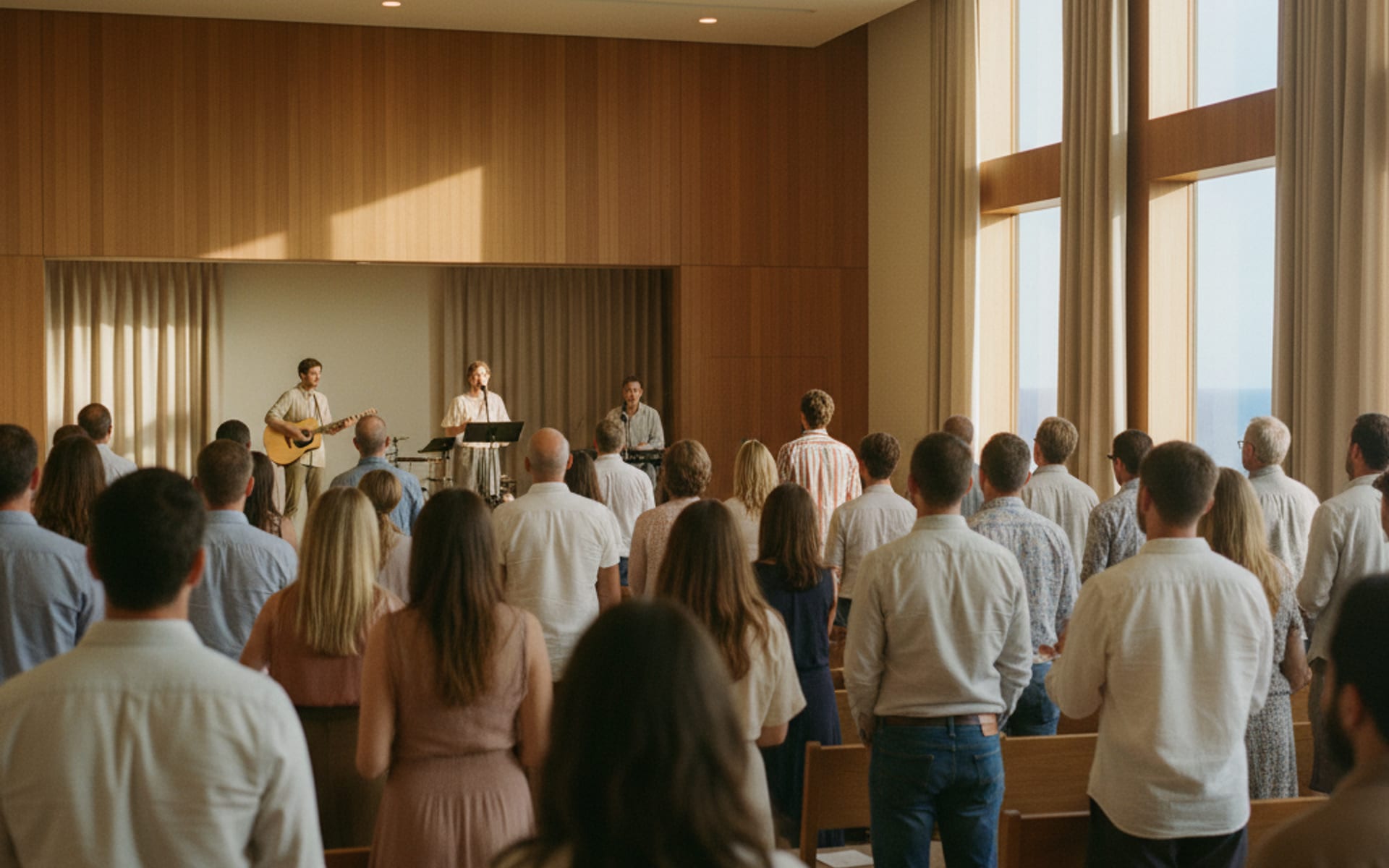
If you’re reading this and wondering what coming on Sunday would be like — no weird pressure, no one singles you out, you can leave whenever. Our plan-your-visit guide walks through the whole thing. Kids get checked into Coast Kids, parking is free, services run about 75 minutes.
Or if Sunday morning is a stretch right now, the livestream runs every week at 9 AM Pacific. Start there. Bring coffee.
You don’t have to go to church. You should want to — eventually — for the five reasons above. But “should” only matters if it’s doing something for you. Try it for a season and see.
Frequently asked questions
- Do I have to go to church to be a Christian?
- Strictly speaking, no — you are saved by grace through faith in Jesus, not by church attendance. But the New Testament assumes Christians gather. Hebrews 10:25 warns against 'giving up meeting together.' Every metaphor for Christians in the Bible (body, family, flock, building) is plural. It is possible to be a Christian without a church, the way it is possible to be a husband without living with your spouse — technically true, practically strange.
- What if the church hurt me?
- That's a real wound and we are sorry. Many people in our church have some version of your story. Healing usually happens in a different community, not in isolation. Start with a low-commitment visit. Sit in the back. Don't tell anyone your history unless you want to. The goal isn't to 'get over it' — it's to experience something healthier and let your nervous system recalibrate.
- Can I just watch the livestream?
- You can — and we stream every service — but a screen is not the same room. You don't become part of a body by watching a video of a body. Livestream is excellent for sick Sundays, travel, and for people exploring before they visit. It's not a long-term replacement. The New Testament word for 'church' (ekklesia) literally means 'gathered assembly.'
- I tried church and it felt fake. Is that just me?
- It's often not just you. Some churches really are performance-heavy, emotion-manipulative, or politically coded in ways that feel off. Try another one. We're non-denominational — churches vary enormously in style and health. Before giving up on church entirely, visit three different ones over six weeks. The variance will surprise you.
- What if I don't know anyone?
- Nobody at church knew anyone the first time. We promise. The fastest way to go from stranger to known is to join a life group — small groups of 8–12 that meet weekly in homes. It's where real community happens; the Sunday service is where you encounter the teaching and worship. Both, over time.
Further reading & references
- Hebrews 10:24–25 — The New Testament's most direct statement on why Christians gather.
- Acts 2:42–47 — The earliest portrait of what a church actually is — and isn't.
- Pew Research — Religious attendance trends — The data on who goes, who left, and why.