
If you’ve never been to a non-denominational church, the term itself can be confusing. “Not a denomination” sounds like it means “outside Christianity” or “made-up religion” or “we believe whatever we want.” It’s none of those things.
This post is for people considering visiting a non-denominational church for the first time. What it means, what’s typical, what’s variable, and what warning signs to watch for.
- ”Non-denominational” means not affiliated with a specific denomination — it’s a structure choice, not a doctrine.
- Most non-denominational churches hold classic evangelical Protestant theology.
- The variation between non-denominational churches is huge. One isn’t representative of all.
- Watch for: clear elder accountability, scriptural depth, financial transparency, healthy leadership.
What “non-denominational” actually means
A denomination is a formal network of churches with shared doctrine, governance, and (usually) name. Examples: Southern Baptist, United Methodist, Presbyterian (PCA, PCUSA, EPC, etc.), Lutheran (ELCA, LCMS), Episcopal, Roman Catholic, Greek Orthodox.
A non-denominational church is one that doesn’t belong to any such network. It might:
- Be entirely independent (no formal external ties).
- Be loosely associated with a network of like-minded churches (like Acts 29, ARC, or Vineyard).
- Be a “denominational church without the denomination’s name” — meaning it holds Baptist or Pentecostal or Reformed theology but doesn’t carry the label.
What it does NOT mean:
- Outside historic Christianity.
- Without doctrine.
- Without accountability.
- Believes whatever the pastor wants.
A healthy non-denominational church has all the substance of a denominational church — it just doesn’t have the formal denominational structure.
7 things to know before visiting
1. The variation is enormous
You cannot generalize about non-denominational churches. They range from theologically conservative to progressive. From charismatic to cessationist. From hyper-modern to vaguely traditional. From small house-church to 10,000-member megachurch. From doctrinally precise to deliberately vague.
Visiting one tells you about that one. It does not tell you what all non-denominational churches are like.
2. The teaching style is usually expositional or topical
Two main patterns:
Expositional — working through a Bible book verse-by-verse over weeks or months. Tends to produce theologically literate congregations.
Topical — addressing a theme or current issue with scripture passages drawn from across the Bible. Tends to be more accessible but can be shallower if not done carefully.
Some churches alternate between the two. We do.
3. Worship is almost always contemporary
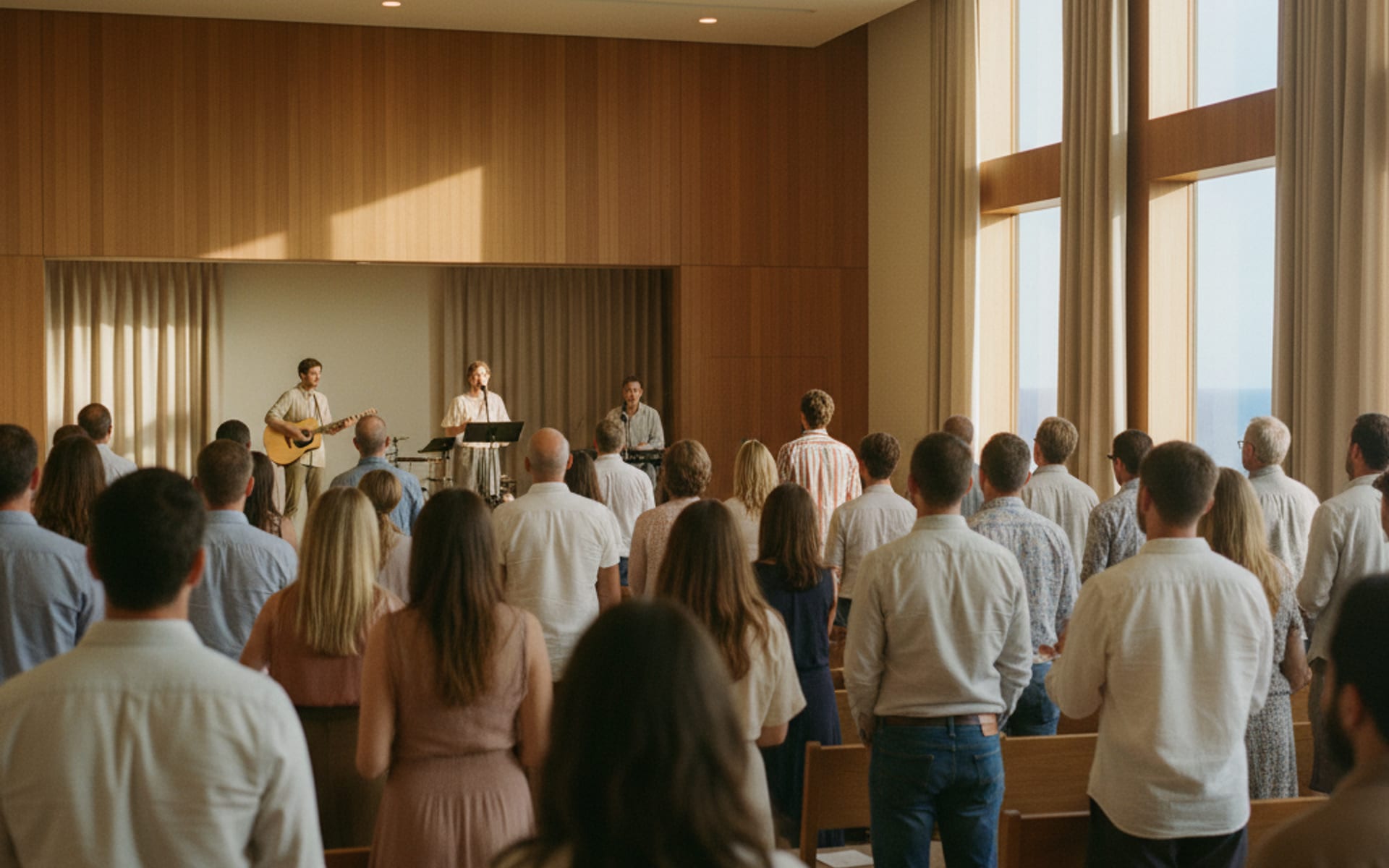
Guitar, drums, keys. Songs written in the last 20 years (with occasional reworked hymns). Bands rather than choirs. Sound system rather than organ. If you grew up with traditional hymns and want them, a non-denominational church will probably feel foreign musically.
4. The Bible is taken seriously
The defining commitment of evangelical non-denominational Christianity is the authority of scripture. Sermons are usually grounded in specific Bible passages. Personal Bible reading is encouraged. Doctrine is built from the Bible up, not from tradition.
This is also true of many denominations — but it’s especially central to non-denominational identity.
5. Communion practice varies
Some non-denominational churches take communion every week. Others monthly. Others quarterly. Some use real bread; some use wafers. Some use wine; some use grape juice. Some practice “open communion” (any believer can participate); some restrict it (members only).
If communion structure matters to you, ask before you visit.
6. Accountability structure matters
This is the single biggest variable in non-denominational health. Some non-denominational churches have:
- Multiple-elder leadership — decisions made by a group of qualified leaders, not a single pastor.
- Outside accountability — board members from other healthy churches, regular external audits.
- Financial transparency — publicly available budgets, salaries within ranges.
- Clear constitutional limits — what the senior pastor can and can’t do without approval.
Others have a celebrity pastor with little real oversight. The latter is where most non-denominational scandals happen. Ask about the elder board before joining a non-denominational church.
7. The community feel is often warmer
Without the formal liturgy of older traditions, non-denominational churches often emphasize hospitality, small groups, and accessible community. This is generally a strength. Some traditions have more transcendent worship; non-denominational churches typically have more relational community.
Both are good. Different churches do different things well.
What we believe specifically (Carlsbad Coast Church)
Since you’re reading this on our site, here’s what we hold to:
- Trinity — one God, three persons (Father, Son, Holy Spirit).
- Scripture — the 66 books of the Bible are God-inspired and authoritative for faith and practice.
- Jesus — fully God and fully human. Born of a virgin. Lived a sinless life. Died on the cross for our sins. Rose bodily from the dead. Coming back.
- Salvation — by grace alone, through faith alone, in Christ alone.
- The Holy Spirit — fully God, indwelling every believer.
- The church — the body of all Christians worldwide, expressed locally in churches like ours.
- The future — Jesus is returning to judge, restore, and dwell with his people.
For the longer version, see /what-we-believe/.
Warning signs of an unhealthy non-denominational church
If you’re visiting one and any of these are present, be careful:
- Single-pastor leadership with no real elder accountability. Concentrated authority is dangerous.
- Pressure to give before you’ve established membership. Healthy churches don’t pressure newcomers financially.
- Claims of special revelation or new doctrine. Be wary of “the Lord told me” replacing “the Bible says.”
- Excessive emotional manipulation in services. Worship should move you, not whip you.
- Unwillingness to publish the statement of faith. What they believe should be publicly available.
- Discouraging visits to other churches. Healthy churches are confident enough to let you visit competitors.
- Cult-of-personality around the senior pastor. The brand should be Jesus, not the leader.
If you see one or two of these in mild form, that’s a yellow flag. If you see several, that’s a red flag.
Should you visit a non-denominational church?
If you’re curious — yes. Here’s how to do it well:
- Read the statement of faith before you go. Should be on the website.
- Visit at least three different ones over a couple of months. The variance will surprise you.
- Listen to a few sermons online before visiting. This tells you more than the website ever will.
- Ask about elder structure early. Healthy churches will explain it readily.
- Don’t commit until you’ve been there for several months. Take your time.
What’s next
- Our pillar resource on what non-denominational means — the deep-dive version.
- Why go to church?
- Can you be a Christian without going to church?
- Plan your visit to Carlsbad Coast Church.
Non-denominational isn’t a downgrade. It’s a different shape of the same Christianity. The healthy ones are warm, theologically substantive, and worth your time. The unhealthy ones, like the unhealthy denominational ones, are best avoided. Choose carefully.
Frequently asked questions
- Are non-denominational churches a real church or a new movement?
- Real church. The non-denominational movement traces to early 20th century reformers wanting to return to the simplicity of the New Testament church — pre-denominational. The format is new (some non-denominational churches are 50 years old, some 5), but the theological commitments are typically classic Protestant Christianity. We hold to the Apostles' Creed and Nicene Creed — the same foundational beliefs as 2,000 years of Christianity.
- What do non-denominational churches actually believe?
- Varies. Most fall within evangelical Protestantism — Trinity, Bible as God's authoritative Word, salvation by grace through faith in Jesus, bodily resurrection, Christ's return. But specific positions on baptism, communion, spiritual gifts, end times, and other secondary issues vary significantly between non-denominational churches. Always read a church's statement of faith before joining.
- Are non-denominational churches less accountable than denominational ones?
- Sometimes, and this is a real concern. Denominations have built-in accountability structures (regional bodies, doctrinal review). Non-denominational churches have to build their own — through elder boards, partner networks, and external advisors. A healthy non-denominational church has clear accountability. An unhealthy one has a celebrity pastor and no checks. Ask about the elder structure before joining.
- Is your worship style traditional or modern?
- Modern at our church specifically. Most non-denominational churches use contemporary worship — guitar, drums, keys, recently-written songs — rather than organ and hymnal. Some non-denominational churches are blended (mix of old and new). Almost none are exclusively traditional. If you grew up with hymns and want hymns, a Reformed or Lutheran or Anglican church will probably feel more familiar.
- Will the teaching be theologically deep or shallow?
- Varies wildly. Some non-denominational churches are theologically rigorous (working through Bible books verse-by-verse, multi-week sermon series, robust catechesis). Others are deliberately surface-level. The only way to know is to listen to a few sermons. We aim for substance — our teaching is expositional and we don't shy away from hard texts.
Further reading & references
- The Apostles' Creed — The earliest Christian creed (~ 2nd century) — the doctrinal foundation most non-denominational churches share.
- Pew Research — Non-denominational Christianity — Statistics on the non-denominational movement in the U.S.
- Our pillar resource: What is a non-denominational church? — The longer-form deep-dive on the topic.