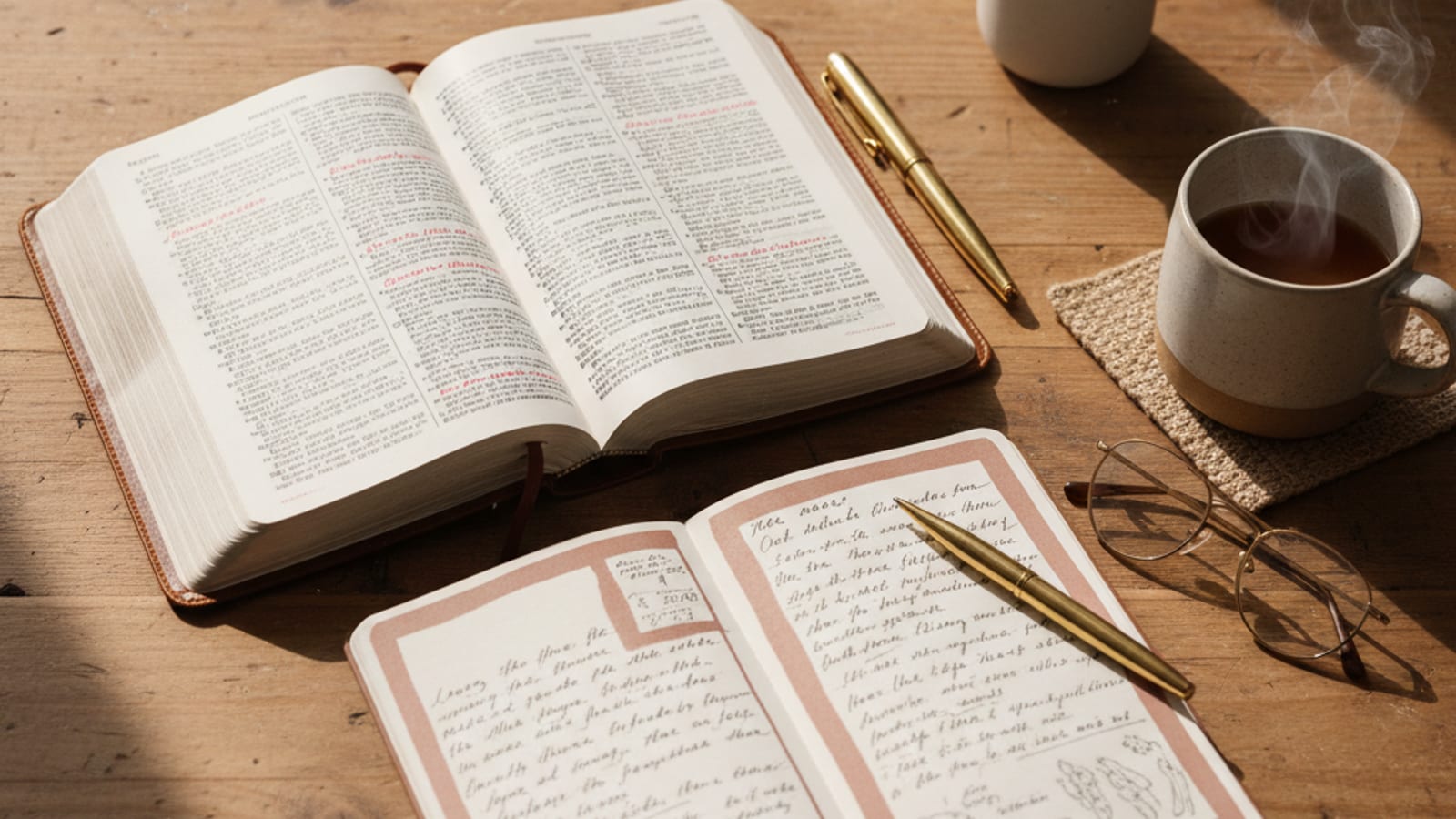
Most Christians want to study the Bible. Most don’t, because they’ve never been taught how. They open it, read for 10 minutes, get lost in Leviticus, and quietly stop.
This post is the method. Five steps. Same approach seminary students learn — just stripped of the jargon. You can do this with a Bible and a notebook.
- The 5 steps: pray, read, observe, interpret, apply.
- Don’t read for total volume. Read for understanding. 5–10 verses studied beats a chapter skimmed.
- Start with one Gospel and one short letter (try Mark + Philippians).
- 20 minutes, four to five times a week, beats an hour once a week.
What Bible study is (vs. Bible reading)
These are different activities.
Bible reading is taking in scripture in larger chunks for general familiarity. Reading through a Bible reading plan, reading Psalms before bed, reading a chapter at breakfast. Goal: cover ground.
Bible study is engaging deeply with a smaller portion of scripture to actually understand what it says. Goal: depth.
Both matter. Most people only read. The depth comes from also studying.
The 5 steps
Step 1: Pray (1 minute)
Before you open your Bible, ask the Holy Spirit to teach you. Psalm 119:18 — “Open my eyes that I may see wonderful things in your law.” This isn’t ritual. The Bible’s own claim is that the Spirit helps you understand scripture (1 Corinthians 2:12-14). Asking is appropriate.
A simple prayer: “Spirit, teach me what you want me to see in this passage today. Show me what’s true. Show me how to live it. Amen.”
Step 2: Read (3-5 minutes)
Read your passage at least twice. Slowly. Out loud if you can.
What’s a passage? For epistles (letters like Romans, Ephesians), one chunk of thought — usually a paragraph in your Bible. For narrative (gospels, Acts), one scene or story. For psalms, one psalm. For the prophets and longer Old Testament books, one section. Don’t overthink length. Aim for 5-15 verses.
The reason for reading twice: the first read is for the gist. The second is for the details you missed.
Step 3: Observe (8-10 minutes)
This is the step most people skip. Take notes. Specifically:
- Who is in the passage? Speakers, audience, characters mentioned.
- What is happening? Action, command, statement, question, prayer.
- When and where? Setting, time period, what came before and after in the book.
- What words repeat? Scripture often emphasizes by repeating.
- What contrasts appear? “But,” “however,” “yet” — these are usually load-bearing words.
- What lists appear? “First, second, third” or numbered things.
- What questions does the text raise? Things you’d want to ask if you could.
Don’t interpret yet. Just notice. This step is the one that makes the rest of the study work.
Step 4: Interpret (5 minutes)
Now you ask: what does this passage mean — to its original audience, in its original context?
Three principles:
Context. The passage means what it meant in its surrounding text. A verse pulled out and isolated can mean anything; in context, it means something specific. Always read at least the chapter around your verse.
Genre. A psalm is poetry — read it as poetry. A historical book is history — read it as history. A letter is a letter — read it as a letter. Don’t read poetry like history or law like wisdom.
Original audience. Who was this written to? The book of James was written to scattered Jewish Christians under persecution. The book of Romans was written to a mixed Jewish-Gentile church in the imperial capital. Knowing the original audience helps you not impose modern American framing on ancient Mediterranean texts.
A study Bible (ESV Study Bible is excellent) gives you most of this in the introduction to each book. Worth investing in eventually.
Step 5: Apply (5 minutes)
Now you ask: what does this mean for my life today?
Application is not always immediate behavior change. Sometimes the application is:
- A truth to believe more deeply.
- A sin to confess.
- A promise to claim.
- A command to obey.
- A prayer to pray.
- A habit to start.
- A relationship to repair.
Write it down. Specifically. Not “I should be more loving.” Better: “I’m going to call my brother this week and apologize for the thing I said at Christmas.”
Vague applications change nothing. Specific applications change lives.
What to study (for beginners)
Order matters. Don’t start in Genesis and try to read straight through — most people quit by Numbers.
Start with one Gospel. Mark is shortest and most action-packed (16 chapters). John is most theological. Either is a good first. Read 5-15 verses a day, work through the whole book over 6-8 weeks.
Then add one short letter. Philippians (4 chapters) and Ephesians (6 chapters) are excellent first letters. Both are accessible and densely meaningful.
Then read another Gospel. Matthew or Luke. Get four perspectives on Jesus.
Then a longer letter. Romans is theologically dense. 1 Corinthians is practical. Either teaches you to read carefully.
Then alternate Old and New Testament. Once you’re past 1 year of consistent study, you can confidently move into Old Testament narrative (Genesis, 1-2 Samuel) and prophets (Isaiah, smaller prophets).
Tools to use
Free, essential:
- Your Bible.
- A notebook.
- BibleGateway.com for searching, comparing translations, and looking up cross-references.
Worth investing in eventually:
- A good study Bible (ESV Study Bible is the standard).
- One commentary on a book you’re studying (NIV Application Commentary series is accessible).
- How to Read the Bible for All Its Worth by Fee & Stuart — the standard accessible introduction.
Optional but useful:
- An app like the YouVersion Bible app (free) for reading on the go.
- Logos Bible Software if you want to go deep (paid; for serious study).
How not to study the Bible
A few common mistakes:
Don’t proof-text. Proof-texting is grabbing a verse out of context to support an idea you already had. The Bible can be made to “say” almost anything if you ignore context.
Don’t only read passages you like. Read all of it eventually. The hard parts are part of the formation.
Don’t skip the Old Testament. It’s two-thirds of the Bible. The New Testament makes way more sense once you know it.
Don’t make it about your feelings. Sometimes you’ll feel nothing while studying. The truth doesn’t depend on your feelings about it. Show up anyway.
Don’t go alone forever. Personal study is good. Group study catches blind spots. Both.
What’s next
- A Bible reading plan for beginners.
- A 1-year Bible reading plan.
- Common misconceptions about the Bible.
- Join a life group — most groups study a Bible book together weekly.
The Bible is a deep book. The good news: you don’t need a seminary to learn how to swim in it. 20 minutes a day, the 5-step method, and consistency over years — that’s the whole secret. Start tomorrow.
Frequently asked questions
- What translation should I use?
- For most adults, the NIV (New International Version) and ESV (English Standard Version) are the gold standards — readable but accurate. For a slightly more literal reading, the NASB. For very accessible language, the NLT (New Living Translation). Avoid The Message for serious study (it's a paraphrase, not a translation) — use it for devotional reading instead. Pick one and stick with it for several years.
- Do I need study Bibles or commentaries?
- Eventually yes, not at first. Start with just the Bible itself for several months. Then add a good study Bible (the ESV Study Bible is excellent). Once you're regularly hitting passages you can't understand, add a commentary or two on books you're studying. Don't start with all the resources — they'll overwhelm you and replace the actual reading.
- How long should Bible study take?
- 20-30 minutes for a focused session. Daily reading (just reading, not studying) can be 10-15 minutes. Don't try to do hour-long deep dives daily — you'll burn out. Better to do 20 minutes 5x a week than 60 minutes once. Study and reading are different activities; both have a place.
- What if a passage doesn't make sense?
- Welcome to Bible study. Some passages are genuinely hard. Three options: skip it for now and come back later, look up a commentary, or ask a pastor. Don't panic. The Bible has plenty of clear passages to grow from while you let the difficult ones marinate.
- Should I study alone or with others?
- Both. Personal study builds depth; group study builds community and catches blind spots. Our life groups do weekly study together. Personal study during the week + group study weekly is a strong rhythm.
Further reading & references
- BibleGateway (free Bible search) — The best free online Bible — 200+ translations, search, parallel comparison.
- ESV Study Bible — The most thorough single-volume study Bible. Worth the investment.
- How to Read the Bible for All Its Worth — Fee & Stuart — The standard accessible introduction to Bible study method.